Last updated: November 18, 2026
Non-surgical skin tightening can make mildly loose face and neck skin look firmer by heating tissue to encourage collagen remodeling. The improvement is usually modest, not a substitute for a facelift or neck lift. At Salisbury Plastic Surgery, our ThermiRF skin-tightening treatment uses a probe beneath the skin, so it is minimally invasive rather than noninvasive.
What is non-surgical skin tightening, and how does it work?
Radiofrequency, ultrasound and some laser treatments heat tissue at targeted depths to stimulate collagen production. Because collagen develops over time, improvement may take months to become visible.
The American Academy of Dermatology distinguishes noninvasive treatments, which leave the skin intact, from minimally invasive treatments that insert a tube or needles to deliver heat beneath it. Both approaches aim to improve firmness, but the difference matters when considering anesthesia, wound care and recovery.
How is ThermiRF different from a treatment applied to the skin’s surface?
Our ThermiRF system uses temperature monitoring as radiofrequency heat is delivered beneath the skin, aiming to tighten loose skin, address unwanted fat and stimulate collagen production. A surface-applied radiofrequency device instead heats underlying tissue through a handpiece placed against the skin. The American Academy of Dermatology says some people feel tightening immediately after surface RF, but the best results generally appear around six months. Some people benefit from more than one treatment, and results can last two to three years with appropriate skin care. Those surface-RF expectations are separate from our ThermiRF timeline and do not predict an individual result.
Do non-surgical skin tightening treatments work?
Energy-based skin tightening can improve mild facial laxity and wrinkles, but results are generally subtler than a surgical lift. In a 2025 prospective study in the Journal of Cosmetic Dermatology, both radiofrequency and focused ultrasound groups had statistically significant improvements in facial laxity and wrinkle scores after treatment.
Researchers assessed patients at one and three months after a single treatment. The study cannot establish how long improvements last or predict results with a different device.
What kinds of changes are realistic without surgery?
For someone with early sagging, a realistic goal is firmer-looking skin and a modestly smoother contour. The American Academy of Dermatology notes that even minimally invasive tightening cannot reproduce the results of a facelift or neck lift. Pronounced jowls, substantial loose neck skin or deeper folds may call for a surgical evaluation if a more noticeable change is the goal.
How do radiofrequency and focused ultrasound compare for the face?
Focused ultrasound delivers energy to planned depths beneath the skin using a handpiece at the surface. Radiofrequency treatments vary: a surface device and a probe placed beneath the skin are different procedures. That distinction is essential when interpreting a comparison of the technologies.
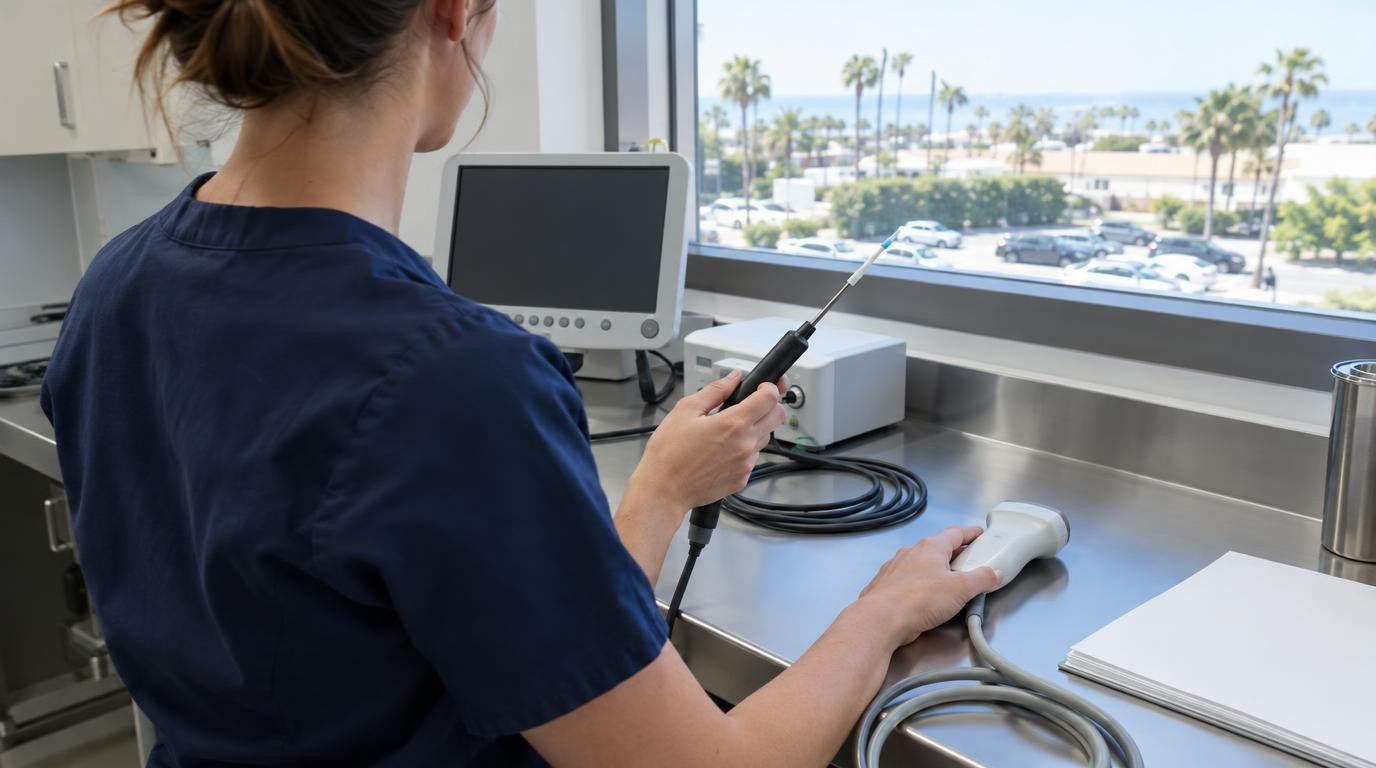
The American Academy of Dermatology says most people see modest lifting and tightening two to six months after one ultrasound treatment, and some benefit from additional treatments. The American Society for Dermatologic Surgery’s Ultherapy guidance says this treatment’s full lifting effect develops over two to three months, may continue improving for up to six months and can last up to a year. That duration is specific to Ultherapy, not a promise for every ultrasound device.
What did the 2025 head-to-head study find?
The Journal of Cosmetic Dermatology study was single-center, single-blind and nonrandomized. After one treatment, three blinded dermatologists assessed participants at baseline, one month and three months. The study’s reported comparison is summarized below.
| Study detail | Reported finding |
|---|---|
| Participants | 36 patients: 21 received radiofrequency and 15 received focused ultrasound |
| Facial scores | Both groups had statistically significant improvements in facial laxity and wrinkle scores |
| Early comparison | At one month, focused ultrasound produced greater improvement in mid-face (p = 0.004) and lower-face (p = 0.046) scores |
| Satisfaction and safety | Both groups reported high satisfaction; no severe adverse reactions were observed |
Can that study tell you whether ThermiRF or ultrasound is better for you?
No. The study assessed facial outcomes, not loose neck skin, and did not compare focused ultrasound with our probe-based ThermiRF procedure. Its nonrandomized design and three-month follow-up also limit what it can tell you about longer-term results.
How does laser resurfacing compare for tightening?
The American Academy of Dermatology describes laser resurfacing as the most effective procedure for tightening loose skin. It says patients generally need to stay home for five to seven days and may see tightening within two weeks after healing. The tradeoff is a greater risk of side effects, including scarring, than with less intensive treatments. Laser resurfacing cannot remove substantial excess skin in place of a facelift or neck lift.
Who is a good candidate for ThermiRF skin tightening?
Our ThermiRF treatment is intended for people with minimal facial wrinkles or folds, mild face or neck sagging, and a desire for smoother, tighter-looking skin without a facelift. Suitability also depends on the area being treated and the change a person hopes to see. More substantial laxity deserves a discussion of surgical options.
At Salisbury Plastic Surgery, Dr. Deborah Ekstrom reviews your condition, medical history and aesthetic goals to plan treatment around you rather than a device category. Mild skin looseness may call for a different approach from substantial excess skin, unwanted fat or changes in deeper facial structures.
For further reading about another provider’s treatment, see its NuEra Tight provider experience article.
What is the most effective treatment for sagging jowls?
RF or focused ultrasound may modestly help early jowling, while a facelift is generally the more effective option when pronounced sagging calls for a substantial lift. The American Board of Cosmetic Surgery says nonsurgical tightening is not effective for pronounced jowling, and the American Academy of Dermatology notes that even minimally invasive tightening cannot reproduce a facelift. Dr. Ekstrom can assess which approach fits your anatomy and goals.
What are some treatments for a saggy neck?
If mild skin looseness is the main concern, radiofrequency or focused ultrasound may provide modest tightening. For fullness driven mainly by fat beneath the chin, the American Society of Plastic Surgeons’ discussion of under-chin fat describes liposuction and radiofrequency-assisted liposuction for selected patients; our ThermiRF treatment also targets unwanted fat alongside loose skin. Fat removal alone will not remove substantial excess skin, and sagging or prominent muscle bands can change which approach is suitable. For considerable excess skin, a neck lift can remove what energy-based treatments cannot, as the American Society of Plastic Surgeons’ neck-lift discussion explains. An examination helps us distinguish skin, fat and muscle concerns before recommending treatment.
What happens during ThermiRF treatment and recovery?
ThermiRF treatment begins with an assessment of your medical history, treatment area and goals. During the procedure, a tiny probe beneath the skin delivers monitored radiofrequency heat to targeted tissue. Our ThermiRF procedure typically takes 60 minutes; recovery depends on the treatment planned.

After noninvasive surface RF or focused ultrasound, many patients feel ready to resume normal activities later the same day or the next day, according to the American Society for Dermatologic Surgery. By contrast, subdermal RF leaves an entry site that needs wound care. The American Academy of Dermatology says minimally invasive tightening generally involves sedation and a few days of downtime; that is general guidance, not a fixed recovery schedule for ThermiRF. We will review your entry-site care and activity restrictions for the treatment planned.
What should you ask about downtime after treatment?
For under-the-skin RF, the American Academy of Dermatology says you will need someone to drive you home, may need a compression garment for 4 or 5 days, and will need to care for the wound. Whether those measures or activity restrictions apply to your ThermiRF treatment depends on your plan. Our comparison of other facial treatments should not be used as a ThermiRF recovery schedule.
What results can you expect, and how long might they last?
Mildly sagging skin may look firmer after ThermiRF, but the degree and duration of improvement vary. With our ThermiRF treatment, results improve gradually over 6–12 months, and optimal results have been known to last 2–3 years. Neither outcome is guaranteed for an individual patient.
You can view Salisbury Plastic Surgery’s before-and-after photo gallery to see the kinds of outcomes our practice presents, keeping in mind that another person’s result may not predict yours.
Can sagging skin be firm again?
Skin with mild laxity can look firmer after collagen-stimulating treatment, although tightening does not restore youthful skin completely. Severe excess skin is unlikely to resolve without surgery. The amount of improvement depends in part on the skin and structures beneath it, which is why a visible change in texture should not be confused with removal of excess skin.
What are the risks of RF skin tightening, and who should avoid it?
Temporary redness and swelling are usual after noninvasive tightening, according to the American Academy of Dermatology. The American Society for Dermatologic Surgery says redness typically resolves within hours, while swelling or bruising, if present, can last up to one to two weeks. Other complications, such as burns, are less common with properly performed noninvasive treatment. Our probe-based ThermiRF has different risks, including discomfort, burns and infection at the entry site; the cited noninvasive guidance does not establish numerical complication rates for ThermiRF.
Call our office promptly for worsening pain, spreading redness, fever, drainage or a suspected burn. Seek urgent care for sudden facial weakness or difficulty breathing. Skin tightening is not recommended during pregnancy or with a skin infection, and certain medications can make treatment unsuitable. Tell your own clinician about medical conditions, implanted devices and medications to determine whether the proposed procedure is suitable for you.
Does a study reporting no severe reactions mean treatment is risk-free?
No. The Journal of Cosmetic Dermatology study observed no severe adverse reactions in either group, but it cannot rule out uncommon complications or establish the safety profile of our different, probe-based procedure.
Frequently Asked Questions
How many skin-tightening sessions will I need?
For some noninvasive RF devices, a series of 2 to 6 treatments may be recommended, according to the American Board of Cosmetic Surgery. The American Society for Dermatologic Surgery notes that treatment counts vary by device, area and patient needs. That range for noninvasive treatments does not establish how many probe-based ThermiRF procedures you would need.
Can skin tightening get rid of vertical neck bands?
Skin tightening alone may not address vertical neck bands because the bands involve the underlying platysma muscle. The American Society for Dermatologic Surgery describes injections that relax those muscles, while the American Board of Cosmetic Surgery describes surgery to tighten loose neck muscles. At Salisbury Plastic Surgery, we assess whether your concern is skin, muscle, fat, or a combination before recommending treatment.
Does noninvasive skin tightening hurt?
Many patients tolerate noninvasive treatment well, but discomfort varies by device and can be noticeable while focused ultrasound energy is delivered. The American Society for Dermatologic Surgery says some treatments may call for topical anesthesia or another form of pain control. We will discuss comfort measures for the procedure you are considering.
Is RF skin tightening suitable for darker skin tones?
The American Academy of Dermatology considers noninvasive skin tightening suitable for people of all skin colors. Because ThermiRF places a probe beneath the skin, that general guidance does not establish its risks for every patient or skin tone.
Can RF skin tightening be combined with Botox or fillers?
Sometimes. An article on the American Board of Cosmetic Surgery website notes that RF treatments can be combined with injectables. Whether to combine ThermiRF with Botox or fillers, and when to perform each treatment, depends on the procedures and the concerns being treated.
Will skin tightening remove dark spots as well as loose skin?
Skin tightening primarily targets laxity, not dark spots. If pigmentation is your main concern, laser resurfacing may be more relevant: the American Academy of Dermatology notes that it can diminish dark spots, fine lines and wrinkles, though it requires downtime and carries risks such as scarring.
What can I do to help maintain skin-tightening results?
Maintaining a stable, healthy weight and protecting your skin from the sun may help support your results. The American Academy of Dermatology also recommends not smoking, avoiding indoor tanning and limiting alcohol for people considering skin tightening. These habits cannot stop aging or guarantee how long ThermiRF results will last; we can discuss a home skin-care plan with you.
How can you choose a skin-tightening plan that fits your goals?
Compare options by how the energy reaches the tissue, whether the procedure punctures the skin, the likely amount and timing of improvement, and the aftercare and risks. The device name alone does not tell you what recovery or result to expect.
Alongside probe-based ThermiRF, Salisbury Plastic Surgery lists Ultherapy, which delivers focused ultrasound through a handpiece on the skin, and Morpheus8, which delivers radiofrequency through microneedles into the skin. These are different delivery methods, and the head-to-head study above did not compare our specific ThermiRF, Ultherapy and Morpheus8 treatments with one another.
What should you ask at a skin-tightening consultation?
- Is the main concern skin laxity, unwanted fat, deeper facial sagging or a combination?
- Would our under-the-skin ThermiRF approach offer enough improvement for the face or neck area you want treated?
- Where will the probe be placed, what aftercare will be needed and when might changes become visible?
- Would a surgical option better match the result you want?
To discuss your goals with Dr. Deborah Ekstrom, contact Salisbury Plastic Surgery in Corona del Mar, California, at 508.755.4825 for a consultation. Our team can help you weigh a modest tightening treatment against other options based on your anatomy and preferred outcome.
This information is general and is not medical advice. Talk to a licensed clinician about your own situation before making a treatment decision.
About the doctors at Salisbury Plastic Surgery
Dr. Deborah K. Ekstrom, MD – Board-certified plastic surgeon, Medical Director and owner of Salisbury Plastic Surgery.
Dr. Juris Bunkis, MD, FACS – Plastic surgeon, diplomate of the American Board of Plastic Surgery and fellow of the American College of Surgeons.